CRITICAL PATH METHOD
Work Programme ≠ Critical Path Method (CPM)
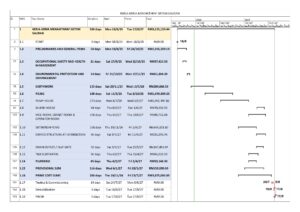
In the construction industry, contractors are required to prepare a work programme. It represents the planned sequence of works from project commencement through to completion.
However, a recurring and material issue we observe on site—despite projects being worth tens of millions of ringgit—is the persistent confusion between a Work Programme and the Critical Path Method (CPM).
A Work Programme is a plan.
CPM is a time management tool.
The critical path is the sequence of activities that determines the project completion date. If any activity on this path is delayed, the entire project completion will be delayed.
CPM is the technical methodology used to identify that path, monitor it continuously, and manage delay risks based on facts—rather than assumptions.
The challenge is that CPM cannot function without data discipline:
The baseline must be preserved
Actual Start and Actual Finish dates must be updated
Tracking Gantt charts must be used to measure finish variance
Updates should be done weekly, not monthly.
Without this discipline, CPM exists in name only.
What commonly happens on projects:
Clients and consultants do not clearly stipulate CPM requirements at the outset
Contractors submit a work programme without genuine CPM tracking
Only after the project is months behind schedule are actual dates requested
By then, the data is already fragmented and reporting becomes inconsistent. As a result, when contractors apply for an Extension of Time (EOT):
Time Impact Analysis cannot be carried out
Event-Based Assessment has to be used instead
EOT decisions become contractual compromises rather than outcomes of robust technical analysis
There are also cases where CPM is deliberately avoided because it is considered difficult to explain to non-technical management:
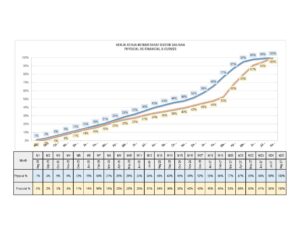
Percentage delay increases but the completion date does not change
The project appears ahead in percentage terms, yet the completion date slips
A 1% delay this month is not equivalent to a 1% delay last month
Ultimately, a linear method that is “easy to understand” is chosen—even though it is technically inaccurate.
The reality today is this:
If clients and consultants do not clearly require CPM and do not know how to review it, contractors will not apply it meaningfully either.
Our view at APS:
From the client’s side, CPM must be established from the very beginning of the project.
The critical path must be identified, logically tested, and corrected where necessary—only then should tracking commence.
If a project is already halfway through, our approach is typically to stabilise the existing situation first, followed by a proactive identification of potential delays that may not yet be apparent to other parties.
Looking ahead, we believe that Engineers, Architects, and Quantity Surveyors must have a basic understanding of CPM.
If CPM is not being used, the document should be clearly labelled as a Work Programme—not otherwise.
Clarity in terminology leads to clarity in management.
And effective time management always begins with the right data—from day one.
—
APS Management Consultant Sdn. Bhd.
“Strategic Project Management, Planning & Recovery Advisory”
“Need Better Project Visibility, Planning or Recovery Direction?”
Speak with APS Management Consultant Sdn. Bhd. to discuss your project challenges, planning requirements or strategic advisory needs.
© APS Management Consultant Sdn. Bhd. All Rights Reserved.